










I met the man who would become my husband in a London airport. I was at a stage in my life where I had worn off dating entirely — a season I had christened Me Time.
So he was just another man — my age, 25 — dispatched by mutual friends to collect me from Heathrow because, as they explained, “Lee is the only one flexible enough to leave work in the afternoon.”
I had purchased one of those suspiciously generous travel deals: Three days in London from San Francisco, where I was a newly minted corporate lawyer already plotting my escape to nonprofit work. Before surrendering the salary, I decided I would see the world. Do it properly, actually.









First stop: Hong Kong to ring in Lunar New Year with red envelopes, parades and fireworks on the mainland. Next stop: London. I had 72 hours to see every castle, locate a proper seaside, eat fish and chips and glimpse one of those red-coated soldiers with the tall black hat guarding a Very Important Door. Then I’d be off to Nairobi for wildebeests.
My plane was scheduled to arrive on a Tuesday at 2 p.m. I would leave Friday morning. That felt like plenty of time.
The flight delay that changed everything

“There’s no wrong way to travel,” a friend once told me. “Anything that gets you out of your apartment and into the world is good and worthwhile.” I liked the sound of that.
My flight arrived nearly two hours late, which meant I was certain I would emerge into Arrivals to find no one. I wouldn’t have blamed Lee. He didn’t know me, and I didn’t know him. I had already decided I’d use the money I’d saved on the travel deal to take a black cab and call it an adventure tax.
With my purse on my shoulder and an All About London pamphlet in my hand, I rolled my tiny suitcase through the arrivals hall, weaving around columns and signs pointing toward baggage claim and transport and reminding visitors to mind the gap. It occurred to me that I didn’t even know what this Lee looked like. And in the era before social media, there was no particular reason he would recognize me either. I’m a Black American girl, I’d told him by email. I’m sure I’ll stick out. But by the time I arrived late, I had no real expectation that anyone would be waiting at all.

Then a flicker of movement to my left caught my eye. A blond man, about 25, leaned from behind a pillar, looked at my travel-worn self, then retreated — or perhaps the crowd simply swallowed him. I walked toward him anyway.
“Hey! Are you Lee?”
He nodded. “You’re Natasha?”
Our eyes caught and I remember thinking — with a certainty I can still feel — This is someone who could care for me deeply, and I for him.
I threw my arms around him. “You’re here! You didn’t have to wait. But thank you!”
I felt his shoulders tense and I pulled away. He wasn’t hugging me back.
“Oh, I’m so sorry,” I said. “You’re English. English people don’t hug. They’re reserved. I read that in my trusty London pamphlet.” I held it up as proof, dog-eared pages marking everything I planned to conquer.
He smiled. “Do it again.”
“Do what again?”
“A hug. I can hug you.”
“No, no thank you. I’m already embarrassed.”
“No,” he said. “Try again.”
I laughed and, in my poshest accent, declared, “I no longer wish to hug you.”
He grabbed my arms and threw them around his neck. We laughed together, hugging like fools — or like old friends — in Heathrow.
We grabbed a bite to eat on the way to the car park and joked about everything, including my seat in the last row of the plane with no recline for a full flight that took a half-day. “They didn’t care about passenger comfort,” I said. By the time we reached the elevator, we bumped the backs of our hands together and, without ceremony, were suddenly holding hands. Neither of us pulled away.
As the elevator doors slid closed, something overtook me — adventure, jet lag, joy. I looked at him slyly and said, “I’m going to marry you one day.”

He didn’t run. He laughed. Then, seeing I might not be entirely joking, smiled and said, “We’ll see.”
Three months later, we were engaged. Three months after that, married. That was 24 years, and we’ve had two children along the way.
When love stories echo across time
Our daughter Ava, now 20, has a boyfriend. She lights up when she talks about him. “He thinks about me when we’re not together,” she says. “He takes care of me. He opens my car door, Mom. All of my doors.”
My husband laughed and said to me, “She’ll get over the car-door thing like you did.” We were sitting on the front porch under the California sun when he said it.

We were waving to neighbors, grateful for the life we’d built. I thought about the car moments that had defined us — my shouting that his reckless driving almost gets me killed, being stuck in freeway traffic extremely pregnant and in labor, twice, or racing to weddings and concerts we were too old to attend. And then I thought of Heathrow.
That first day after he loaded my suitcase into the boot of his car, we walked toward what we assumed were our respective doors, bumping into each other as we crossed behind the car. I headed toward the right side — the passenger side in America.
“You driving?” he laughed.
“Ah,” I said smiling and holding up my trusty pamphlet again, “You guys drive on the wrong side of the road.” I moved to the left side of the car and waited outside the passenger door.
He climbed into the driver’s seat, leaned across and said through the window, “It’s open.”
I said nothing.
“It’s open!” he repeated, gesturing toward the handle.
I waited. Then I thought: He’s waited two extra hours for you. Get over yourself, woman! He doesn’t need to open your door.

I opened it, slid in and said lightly, “I have a checklist for my future husband, and he opens car doors.”
We both laughed. I assumed he was relieved to have dodged the bullet of a wild American woman wanting his hand in marriage.
I loved our love story — the surprise of it, the speed, the absurdity, the way it felt like someone else’s story I’d been dropped into — a story of learning what “care” even means. How to express it, how to receive it. Not just a list of To Do items to check off because, weighted wrongly (or ignored), even completed actions tell lies.
That day on our porch, I said to my husband, “I never stopped wanting it, you know. To have my car door opened.”
I could feel him smiling before he spoke, probably preparing to say something cheeky to keep things light. So I said it plainly:
“I never stopped wanting to feel like somebody’s precious cargo.”
A family trip to Catalina Island
Care has expanded over all these years. Sometimes, it’s a door held open. Sometimes it’s planning a ferry across the water.

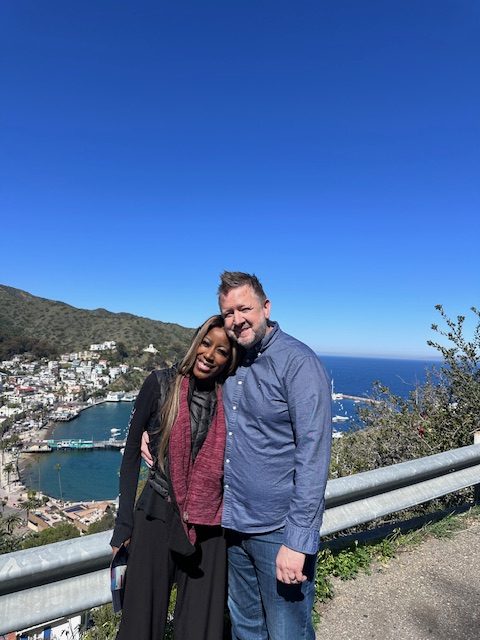
Since then, we’ve traveled the world many times together. Our most recent winter jaunt was an hour across Los Angeles County, to Catalina Island, our first visit, filled with great food from Maggie’s Blue Rose, and then a submarine ride through schools of tropical fish, mini golf and a day of golf carting around the island, including a climb to a lookout where cactus, wild buffalo, the ocean and distant snow-capped mountains shared the same horizon in 68-degree air.
From the balcony of our Bellanca Hotel room, the view stretched from sunrise to sunset. Church bells rang not quite on the hour — rather, 33 minutes after, 45 after—and every time I’d say, “Almost perfect.”
And almost, I’ve learned, is 100 percent.
Nearly a quarter century after Heathrow, Lee opens my car doors now. And when we recently stepped onto the Catalina Express ferry in San Pedro with our family, greeted by cheerful staff and open seats facing the sea, I nudged him and said, “See? We’re precious today.”
Natashia Deón is a two-time NAACP Image Award nominee for Outstanding Literature for her novels “Grace” and “The Perishing.” Her new WWII novel, “Birds of War,” will be published February 2027.